Add9 Chords: What Add9 Means and How to Play Them
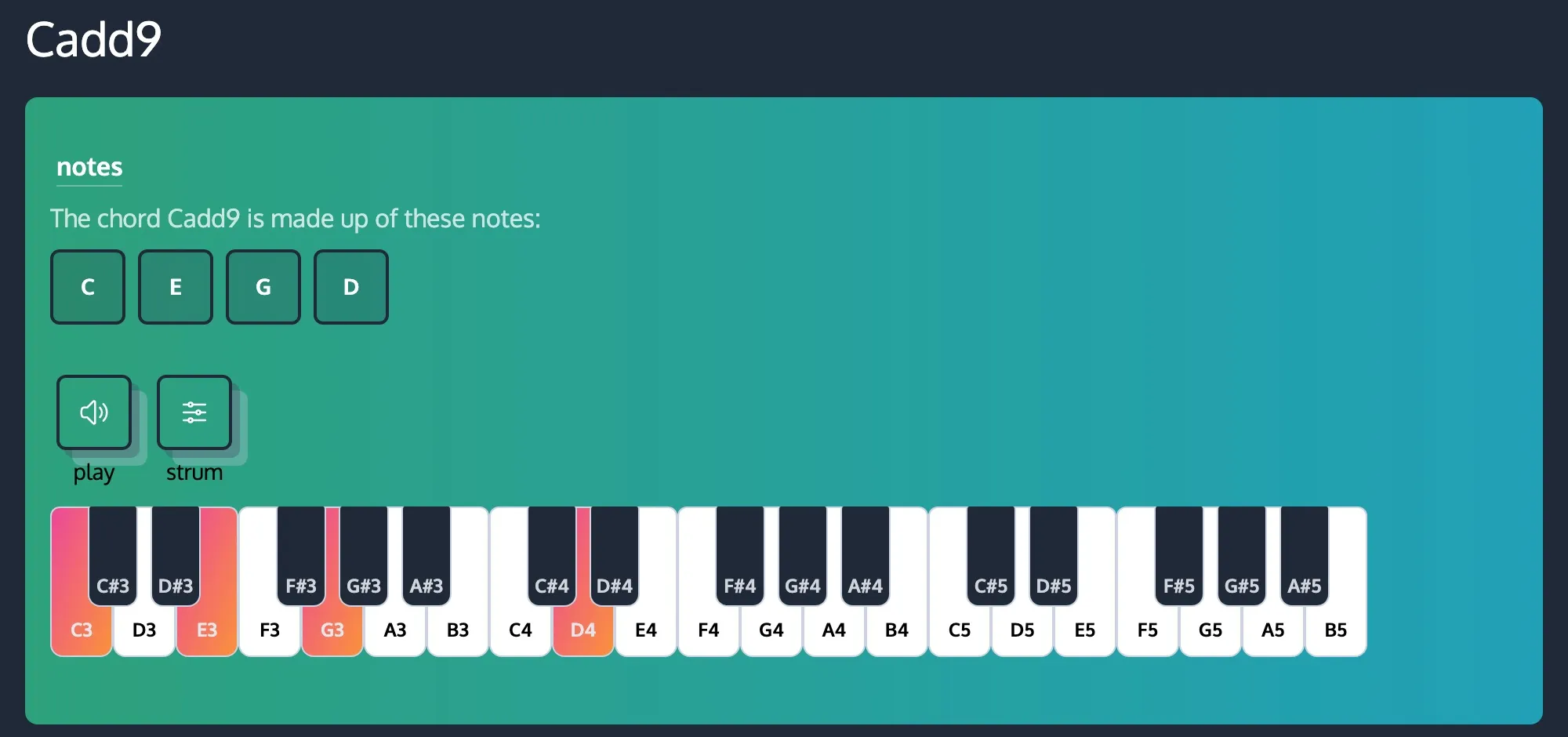
An add9 chord is an ordinary triad with one extra note stacked on top: the 9th, which is the 2nd of the scale moved up an octave. Nothing is removed. Cadd9 is C, E, G, D, which is a plain C major with a D sitting above it. The third stays, so the chord is still unambiguously major, just brighter and less settled.
Here is a plain C followed by Cadd9, so you can hear exactly what that one note buys you:
The second chord is not more complicated in any emotional sense. It is the same chord with a window open.
What the 9 in add9 actually is
The 9th and the 2nd are the same pitch class. In C major, the 2nd note of the scale is D, and the 9th is that same D one octave higher. So why do chord charts bother with two names?
Because the number tells you where the note sits, and where it sits changes everything about how the chord sounds. A D squeezed in right next to the C and E is a cluster: three notes inside four semitones, which grinds. The same D placed an octave up has room to ring, and it reads as colour rather than clash.
| Written | Notes, low to high | What you hear |
|---|---|---|
| C | C, E, G | the plain major triad |
| Cadd9 | C, E, G, D | major, with a bright note floating on top |
| Csus2 | C, D, G | no third at all, hollow and undecided |
That last row is the comparison people trip over most often, and sus chords covers it in full from the other direction. The one-line version: sus2 takes the third out, add9 leaves it in. They are not variations on each other. They are opposite decisions about the most important note in the chord.
You will occasionally see the same chord written as add2 rather than add9. Most of the time the writer means exactly the same thing and picked the other name. Strictly, add2 asks for the D down in the cluster and add9 asks for it up top, but outside of arranging and orchestration almost nobody is that precise. Play it as add9 unless the voicing on the page says otherwise.
Add9 vs 9: the difference is a note nobody mentions
This one matters more than the sus2 confusion, because getting it wrong changes the chord’s job in the song.
A chord written as plain C9 is not “C with a 9th added.” It is a dominant seventh with a 9th on top, which means it quietly includes a Bb you never asked for.
| Chord | Notes | Contains a b7? | Wants to resolve? |
|---|---|---|---|
| Cadd9 | C, E, G, D | no | no, it is perfectly happy where it is |
| C9 | C, E, G, Bb, D | yes | yes, hard, usually to F |
The Bb is doing all the work in that second chord. It turns a stable, shimmering major chord into something with somewhere to be. If you write Cadd9 into a chart and a session player reads C9, your open, floating verse chord becomes a blues turnaround.
The rule underneath the naming: any number on its own implies every odd note below it. C9 implies the 7th. C11 implies the 7th and the 9th. The word “add” is what switches that off, which is the whole reason it exists. If you want the 9 and nothing else, you have to say add.
Cadd9, the one everyone looks up
Cadd9 gets searched more than every other add9 chord combined, and the reason is not that it sounds better than the rest. It is that on a guitar it is almost free.
Take an open G shape with the third and fourth fingers on the top two strings, move to a C, and the two fingers you already have parked on the third fret can just stay there. What comes out is Cadd9. Whole generations of acoustic songwriting run on that laziness, which is why the G to Cadd9 move sounds instantly familiar:
On a keyboard you have to want it, which is arguably better, because you choose it for the sound instead of inheriting it from a fingering. Cadd9 is C, E, G, D. The most common piano voicing puts C and G in the left hand and E and D together up in the right, which keeps the D well clear of the E below it.
Its close relatives get looked up for the same guitar reason: Gadd9 (G, B, D, A), Dadd9 (D, F#, A, E) and Aadd9 (A, C#, E, B) are all one finger away from shapes a beginner already knows.
Minor add9: bright and sad at the same time
Add a 9th to a minor triad and you get something more interesting than the major version. Emadd9 is E, G, B, F#. The chord is still minor, because the G is still there doing its job, but the F# floating on top refuses to be gloomy about it.
That combination, a minor chord with a bright note that will not resolve, is why madd9 chords turn up constantly in film scores, ambient music and anything trying to sound wistful rather than simply sad. It is unresolved in a way a plain minor triad never is.
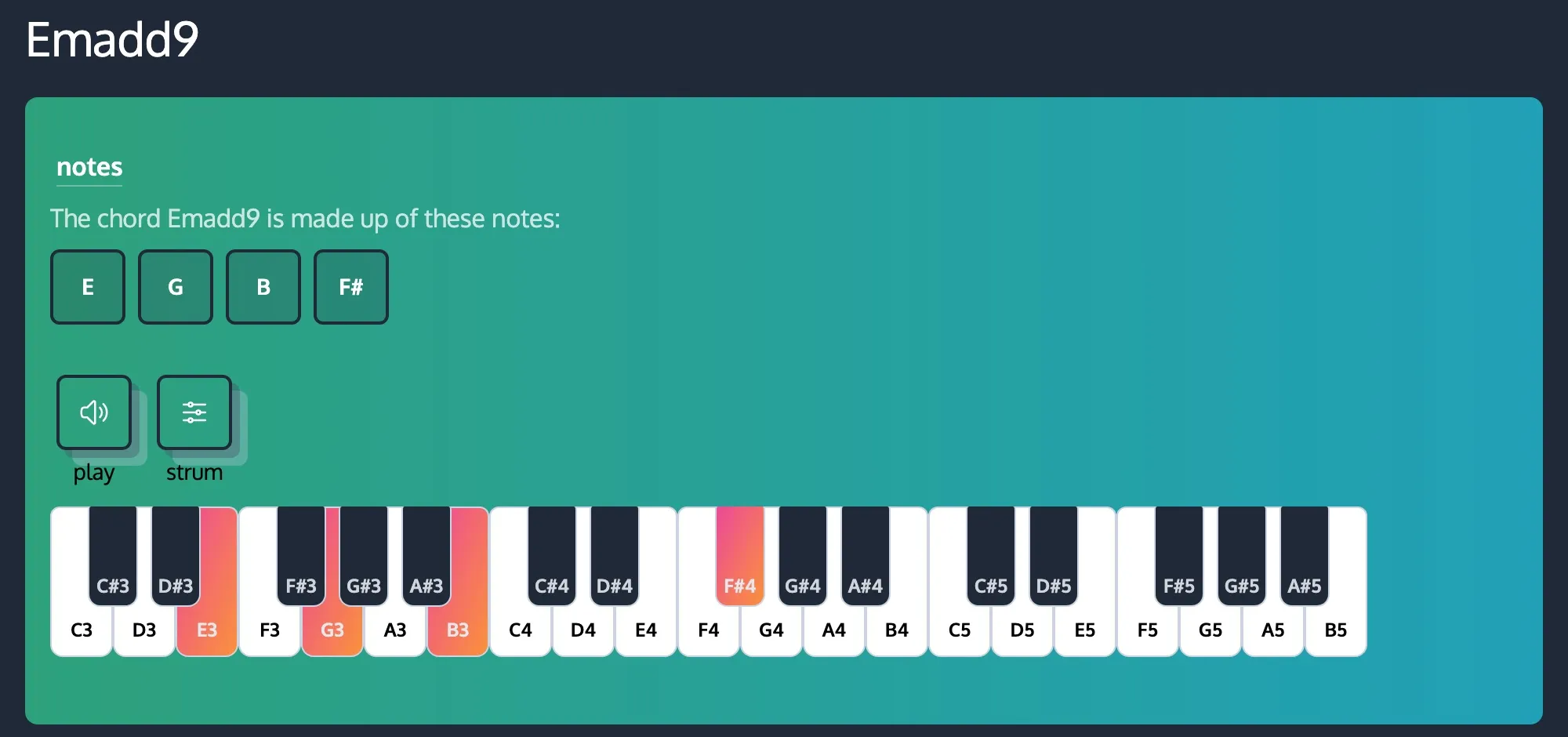
Look at where the F# lands on that keyboard. It is up at F#4, a full octave above the E the chord is built on, and that gap is the whole reason the chord sounds like light rather than tension.
The most-used ones are Emadd9, Amadd9 (A, C, E, B) and Dmadd9 (D, F, A, E). Amadd9 is worth a special mention because its 9th, B, sits a semitone above the C that makes the chord minor. Voice those two notes next to each other and it bites. Spread them an octave apart and it glows. Same chord, and the only thing that changed was where you put your hands.
If minor chords with an unresolved edge are the sound you are after, sad chord progressions groups a lot of them by exactly which flavour of sad they produce.
Add9 chords in every key
Both are formulas and they transpose without thinking. Major add9 is root, 3rd, 5th, 9th. Minor add9 is root, b3rd, 5th, 9th. Every one links to its own page if you want the interactive keyboard, the inversions and a play button.
| Root | Major add9 | Notes | Minor add9 | Notes |
|---|---|---|---|---|
| C | Cadd9 | C, E, G, D | Cmadd9 | C, Eb, G, D |
| C# | C#add9 | C#, E#, G#, D# | C#madd9 | C#, E, G#, D# |
| D | Dadd9 | D, F#, A, E | Dmadd9 | D, F, A, E |
| Eb | Ebadd9 | Eb, G, Bb, F | Ebmadd9 | Eb, Gb, Bb, F |
| E | Eadd9 | E, G#, B, F# | Emadd9 | E, G, B, F# |
| F | Fadd9 | F, A, C, G | Fmadd9 | F, Ab, C, G |
| F# | F#add9 | F#, A#, C#, G# | F#madd9 | F#, A, C#, G# |
| G | Gadd9 | G, B, D, A | Gmadd9 | G, Bb, D, A |
| Ab | Abadd9 | Ab, C, Eb, Bb | Abmadd9 | Ab, Cb, Eb, Bb |
| A | Aadd9 | A, C#, E, B | Amadd9 | A, C, E, B |
| Bb | Bbadd9 | Bb, D, F, C | Bbmadd9 | Bb, Db, F, C |
| B | Badd9 | B, D#, F#, C# | Bmadd9 | B, D, F#, C# |
A couple of the spellings above look strange and are correct anyway. C#add9 really does contain E#, which is the same key as F, because the chord’s third has to be spelled as some kind of E when the root is C#. Same story with the Cb in Abmadd9. Play the key your ear expects; the spelling is bookkeeping for the key signature, not an instruction to find a different note.
Where add9 chords earn their place
An add9 does not change what a chord does in a progression. Cadd9 is still the I chord, still stable, still home. What it changes is how much the chord insists on that. Three uses that come up over and over:
Stop a repeated chord from going flat. If a section sits on one chord for eight bars, alternating the plain triad with its add9 keeps it alive without changing the harmony at all.
Soften a landing. The most common trick in the book: resolve to the add9 instead of the triad, so arriving home does not feel quite so final. Useful when a verse has to keep moving.
Make a whole progression shimmer. Put the 9th on every chord and the individual colour stops registering as an effect. It becomes the texture of the section, which is most of what people mean when they call a track “cinematic.”
That is I, V, vi, IV, the most-used progression in pop music, with a single note added to each chord. Same bones, completely different room.
Voicing add9 so it does not turn to mud
Add9 is the chord most often ruined by how it is played rather than which notes are in it, and there is really only one rule: keep the 9th away from the third.
In Cadd9 the two notes in question are E and D. Put the D immediately below the E and you get a semitone-plus-a-tone cluster in the middle of the chord, which sounds like a mistake rather than a colour. Put the D above the E, ideally with a bit of air under it, and the chord opens up.
Practical version, for either instrument:
- Root and fifth low, the 9th high. C and G in the left hand, E and D up in the right.
- If the chord sounds muddy, the 9th is too low. Move it up an octave before you try anything else.
- On guitar this is mostly handled for you: the standard Cadd9 shape puts the D on the second string, well above the E.
- In a mix with a bass player, drop the root. Cadd9 without its C is E, G, D, which is lighter and lets the bass define the chord.
The same rule is why Amadd9 needs more care than the others. Its 9th and its third are a semitone apart, so a careless voicing does not sound colourful, it sounds wrong. That is the chord to check first if a progression using add9 is not sitting right.
If you want to try any of this without working out voicings by hand, the chord finder will show you any add9 chord’s notes and inversions on a keyboard, and you can hear each one before committing it to a track.
Quick answers
What does add9 mean in a chord? It means play the normal triad and add the 9th, which is the 2nd of the scale an octave up. Nothing is removed, so the chord keeps its third and stays major or minor.
What notes are in a Cadd9 chord? C, E, G and D. It is a C major triad with a D added above it.
What is the difference between add9 and 9? A chord written as plain 9, like C9, includes the flat 7th as well as the 9th, so it is a dominant chord that wants to resolve. Add9 means the 9th only, with no 7th, so the chord stays stable.
Is add9 the same as sus2? No, and they are close to opposites. Sus2 removes the third; add9 keeps it and stacks the 9th on top. Csus2 is C, D, G. Cadd9 is C, E, G, D.
Is add9 the same as add2? In practice, almost always yes. Strictly, add2 puts the extra note down beside the root and add9 puts it an octave higher, but most chord charts use the two names interchangeably.
What is a madd9 chord? A minor triad with the 9th added. Emadd9 is E, G, B, F#. It stays minor but sounds wistful rather than heavy, because the 9th is bright and never resolves.
Why does Cadd9 sound muddy when I play it? The 9th is sitting too close to the third. Move the D above the E rather than below it, and leave some space between them.
Can you use add9 on any chord? On major and minor triads, yes, and it almost always works. On diminished and augmented chords it is rare, because those chords are already unstable enough without a 9th on top.