Sus Chords: What Sus2 and Sus4 Actually Do
A sus chord is an ordinary triad with its third taken out and replaced by the note next door: the 2nd in a sus2, the 4th in a sus4. “Sus” is short for suspended. Because the third is the note that decides whether a chord is major or minor, removing it leaves something that is neither, which is why sus chords sound open and unsettled rather than happy or sad.
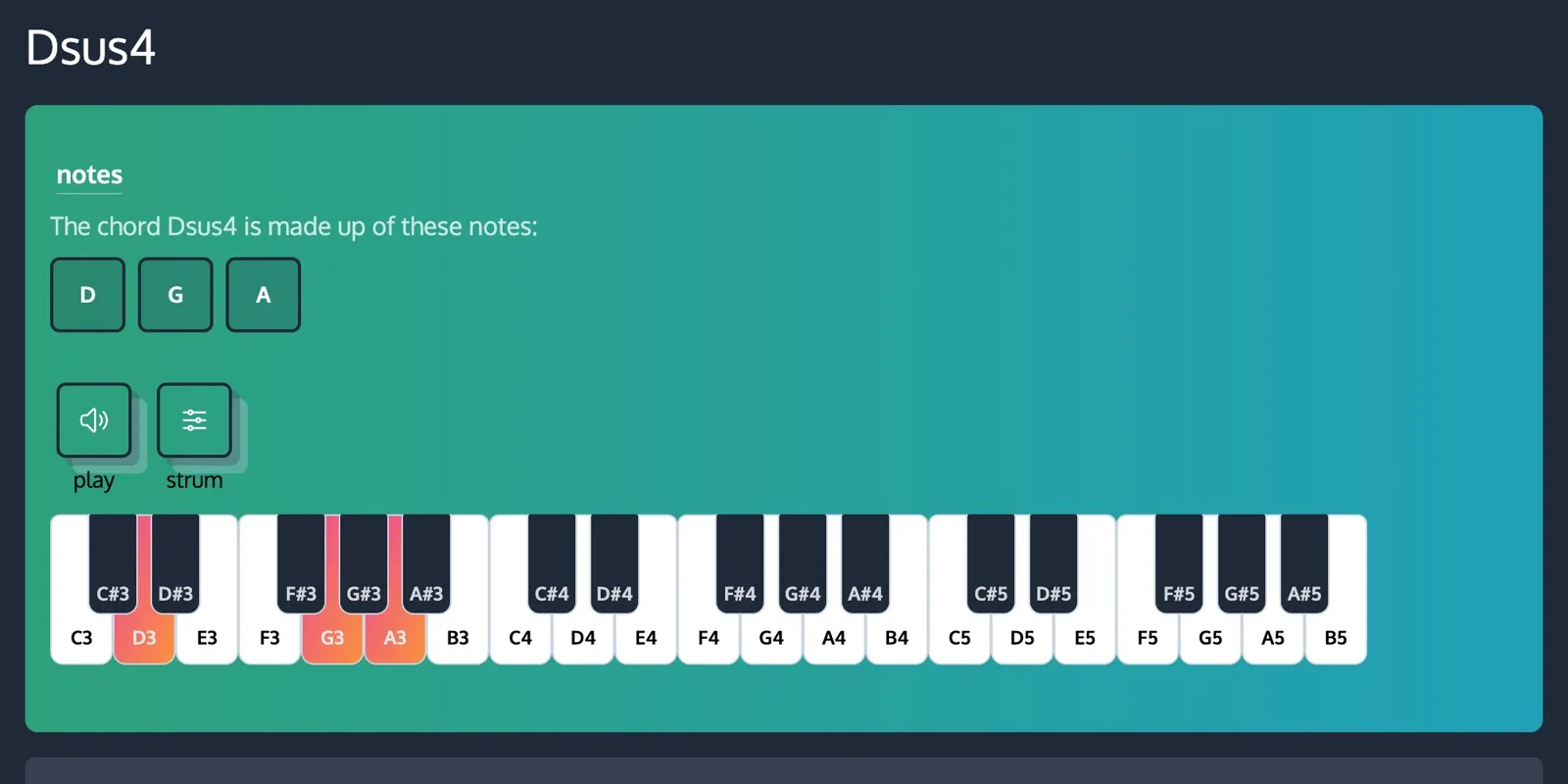
That is the whole definition, and it means very little until you hear it. Here is a Dsus4 followed by the plain D it wants to become:
The second chord is the release. Everything else on this page is about controlling that moment, or deliberately withholding it.
What “suspended” actually means
A plain major triad is three notes: a root, a third and a fifth. C major is C, E, G. The E is doing all the emotional work. Lower it a semitone to Eb and you have C minor. It is the only note in the chord with an opinion.
A sus chord removes that note and puts a neighbour in its place:
| Chord | Notes | What replaced the third |
|---|---|---|
| C | C, E, G | nothing, this is the plain triad |
| Csus2 | C, D, G | the 2nd, a whole step below E |
| Csus4 | C, F, G | the 4th, a half step above E |
The name comes from older music, where a suspension was a note held over from the previous chord after the harmony underneath had already moved on. The held note clashed for a beat, then fell into place. Modern chord charts kept the word but dropped the requirement: nobody expects a Dsus4 in a pop song to have been prepared in the bar before. It is now just a chord you can reach for.
Sus2 vs sus4, and what each one is for
These two get filed together because they are built the same way, but they do not behave alike at all. The difference comes down to how far the replacement note sits from the third it replaced.
| Property | Sus2 | Sus4 |
|---|---|---|
| Replacement note | the 2nd | the 4th |
| Distance from the third | a whole step below | a half step above |
| Tension | mild, more colour than pull | strong, leans hard |
| Typical use | static, sits there unresolved | resolves, usually straight away |
| Feels like | open, airy, modern | held breath |
Hear the difference back to back. First Csus2, then Csus4, each followed by plain C:
The sus2 barely needs the C after it. It is perfectly happy on its own, which is why guitarists in the eighties built entire arpeggiated parts out of sus2 and add9 shapes and never resolved any of them. Andy Summers’ playing with The Police is the usual reference point for that sound.
The sus4 is a different animal. Its 4th sits a half step above the third it displaced, and a half step is the tightest interval in the system. The chord audibly wants to drop that one note and become the triad it is standing in for. Leaving a sus4 unresolved is a choice you make on purpose, not a place you land by accident.
Why sus2 and sus4 are the same three notes
Look at Csus2 (C, D, G) and Gsus4 (G, C, D). Same three pitches, different note on the bottom. Every sus2 is a sus4 built on its own fifth, and every sus4 is a sus2 built on its own fourth.
This is not trivia. It means the label depends entirely on which note the bass is playing. Put a G underneath and the ear hears a suspended G wanting to resolve to G major. Put a C underneath and the same three notes turn into a calm, open C. If a sus chord in your progression sounds wrong, the bass note is the first thing to check.
How a sus chord resolves
The classic move is a sus4 falling to the triad, and the reason it works is that only one note moves, by the smallest distance available. In Gsus4 to G, the C drops to B. Nothing else changes.
That is a V chord decorated on its way home, which is where sus4 chords earn their keep. Delaying the resolution by a beat makes the arrival feel earned rather than automatic.
Sus2 resolves in the opposite direction: the 2nd climbs up to the third rather than falling to it. It is a gentler motion and easier to miss, which is part of why sus2 chords so often just stay put.
Three ways to handle the resolution, in rough order of how often you will want them:
- Resolve immediately. Sus4 on the upbeat, triad on the downbeat. Standard, invisible, always works.
- Resolve late. Hold the sus for a full bar and land the triad at the start of the next one. Much more dramatic, and it only works once or twice in a song.
- Never resolve. Move to a completely different chord and leave the suspension hanging. This is how sus chords stop being an ornament and start being the actual harmony, which is the trick behind the next section.
Sus chords vs add chords
This is the single most common point of confusion, and it is worth two minutes because the two are genuinely different chords that sound nothing alike.
| Property | Csus2 | Cadd9 |
|---|---|---|
| Notes | C, D, G | C, E, G, D |
| Third | removed | still there |
| Major or minor? | neither | major |
| Character | hollow, ambiguous | major with a sparkle on top |
A sus chord takes the third away. An add chord keeps it and stacks an extra note on top. Because Cadd9 still has its E, it is unambiguously a major chord, just a brighter one. Csus2 has no third at all and refuses to commit.
The 2nd and the 9th are the same note an octave apart, which is where the confusion starts. If a chart writes sus2 it means the third is gone. If it writes add9 the third stays.
The add side of that comparison has its own quirks worth knowing, including why a plain C9 is a different chord again. Add9 chords covers them.
What about 7sus4?
A 7sus4 is a dominant seventh with the same substitution applied: root, 4th, 5th, flat 7th. G7sus4 is G, C, D, F. It carries the forward motion of a dominant chord without the sharp edge of the tritone between the third and the seventh, because the third is not there to form one.
That resolution, 7sus4 into the dominant into the tonic, is a jazz and gospel staple. But the more interesting use is the opposite one: leave it alone. Herbie Hancock’s “Maiden Voyage” is built largely on suspended seventh chords that never resolve to anything, and the result floats rather than pushes. Lofi and neo-soul producers lean on the same effect for the same reason.
Sus chords in every key
Both shapes are formulas, so they transpose without thinking. Sus2 is root, 2nd, 5th. Sus4 is root, 4th, 5th. Here is every one, with the notes spelled out. Each links to its own page if you want the interactive keyboard, the inversions and a play button.
| Root | Sus2 | Notes | Sus4 | Notes |
|---|---|---|---|---|
| C | Csus2 | C, D, G | Csus4 | C, F, G |
| C# | C#sus2 | C#, D#, G# | C#sus4 | C#, F#, G# |
| D | Dsus2 | D, E, A | Dsus4 | D, G, A |
| Eb | Ebsus2 | Eb, F, Bb | Ebsus4 | Eb, Ab, Bb |
| E | Esus2 | E, F#, B | Esus4 | E, A, B |
| F | Fsus2 | F, G, C | Fsus4 | F, Bb, C |
| F# | F#sus2 | F#, G#, C# | F#sus4 | F#, B, C# |
| G | Gsus2 | G, A, D | Gsus4 | G, C, D |
| Ab | Absus2 | Ab, Bb, Eb | Absus4 | Ab, Db, Eb |
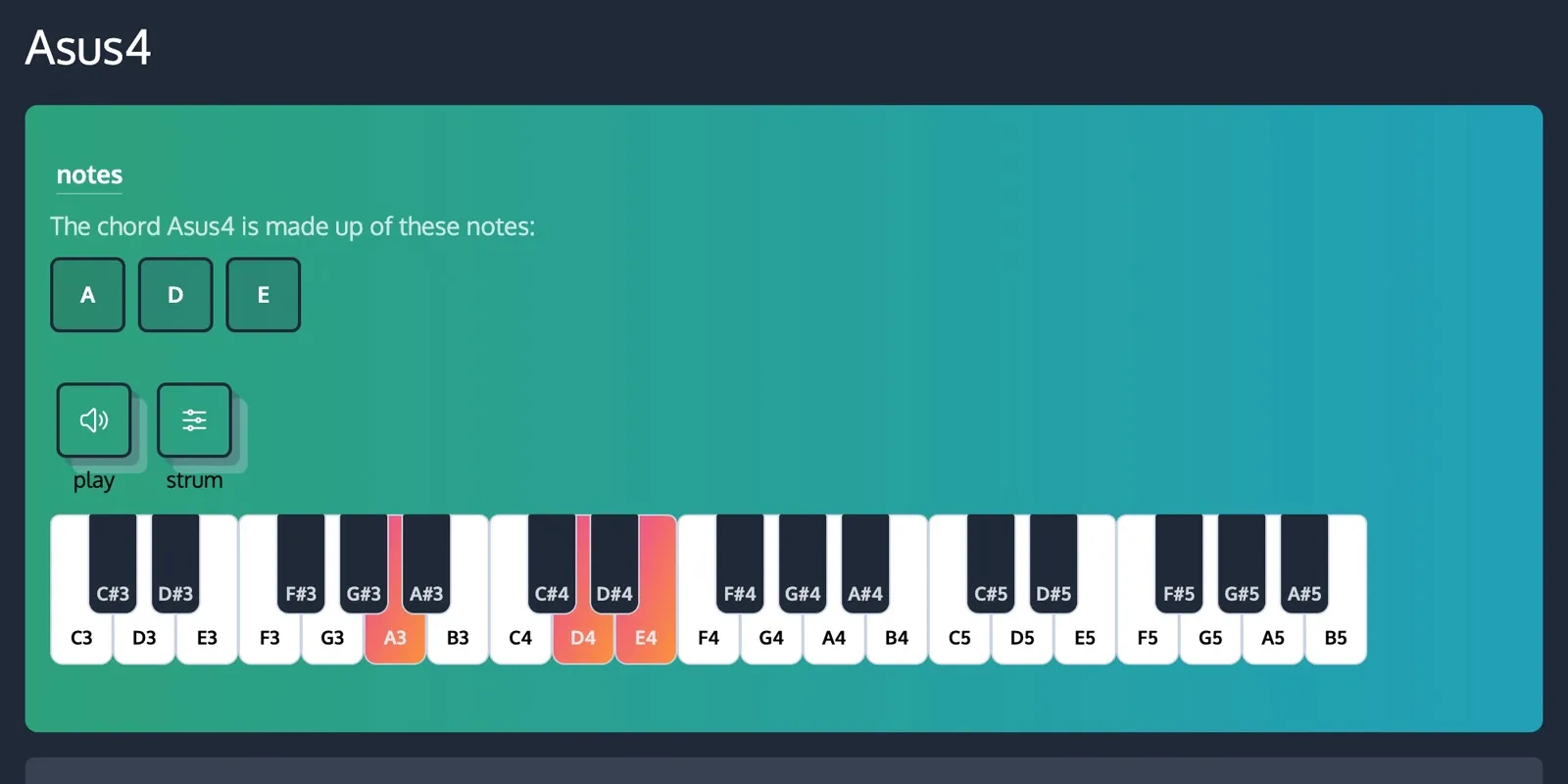
| A | Asus2 | A, B, E | Asus4 | A, D, E |
| Bb | Bbsus2 | Bb, C, F | Bbsus4 | Bb, Eb, F |
| B | Bsus2 | B, C#, F# | Bsus4 | B, E, F# |
One labelling quirk to know: a chord written as plain “Csus” with no number after it almost always means sus4. Sus2 is nearly always spelled out. If a chart hands you a bare Gsus, play Gsus4.
The Asus chord, since it is the one people ask about most
Asus4 is A, D, E. Asus2 is A, B, E. It comes up more than any other sus chord because on a guitar it needs one finger moved from an open A shape, so it turns up constantly in songs written on an acoustic.
If you want to see it on a keyboard, hear it and browse its inversions, the Asus4 page does all three.
Using sus chords in a progression
Three patterns cover almost everything you will actually do with them.
Embellish a chord you are sitting on. If a progression parks on one chord for two bars, a sus4 is the cheapest way to stop it feeling static. Nothing about the harmony changes, so it cannot go wrong.
That figure, a chord wobbling between its sus4 and sus2, is the backbone of a lot of acoustic rock. The intro to Bryan Adams’ “Summer of ’69” is the version most guitarists learn first.
Delay a cadence. Put the sus4 on the V chord just before it resolves, so the return home takes an extra beat.
Use them as the harmony itself. Stop resolving and the sus chords stop being decoration. This one never lands on a plain triad at all:
Ambiguous, a little cold, and impossible to call major or minor, which is exactly what you want when a vocal or a lead line needs room to decide the mood instead.
If you are still getting your bearings with how chords are built in the first place, what is a chord covers the ground underneath this post. And once you have a progression you like, six time-tested chord progressions is a good place to find somewhere to put these.
Quick answers
What does sus mean in a chord? Suspended. The chord’s third has been replaced by either the 2nd (sus2) or the 4th (sus4), leaving a chord that is neither major nor minor.
Is a sus chord major or minor? Neither. The third is the note that decides major or minor, and a sus chord does not have one.
What is the difference between sus2 and sus4? Sus2 replaces the third with the 2nd, a whole step below it, and sounds open and stable. Sus4 replaces it with the 4th, a half step above it, and sounds tense enough that it usually wants to resolve.
What notes are in an Asus chord? Asus4 is A, D, E. Asus2 is A, B, E. A chord written as plain “Asus” means Asus4.
Do sus chords have to resolve? No. Sus4 chords pull strongly enough that resolving them is the default, but plenty of songs leave them hanging on purpose. Sus2 chords often never resolve at all.
What is a 7sus4 chord? A dominant seventh with the third swapped for the 4th. G7sus4 is G, C, D, F. It keeps a dominant chord’s forward motion but sounds softer, and it is common in jazz, gospel and lofi.
What is the difference between sus2 and add9? Csus2 (C, D, G) removes the third. Cadd9 (C, E, G, D) keeps the third and adds the 9th above it, so it is still a major chord.