7th Chords: Maj7, m7 and Dominant 7 Explained
A 7th chord is an ordinary three-note triad with a fourth note stacked on top, a 7th above the root. That one extra note is the whole story: keep the triad major and add a major 7th and you get Cmaj7, soft and floating. Flatten that same 7th and you get C7, which sounds restless and wants to move. Flatten the third as well and you get Cm7, which sounds like almost every lo-fi and neo-soul record ever made.
Three chords, one note apart from each other, three completely different jobs. Most guides show you the shapes and leave you to work out which one you actually want. This one puts them next to each other so you can hear the difference, then gives you all three on every root note.
If you are not solid on triads yet, what a chord actually is covers that ground first and takes about five minutes.
The one note that separates all three
Every 7th chord is built the same way: take the 1st, 3rd, 5th and 7th notes of a scale. What changes between them is whether the 3rd and the 7th are major or flattened.
| Chord | Formula | Example | Notes | Sounds like |
|---|---|---|---|---|
| Major 7th (maj7) | 1, 3, 5, 7 | Cmaj7 | C, E, G, B | Dreamy, settled, floating |
| Dominant 7th (7) | 1, 3, 5, b7 | C7 | C, E, G, Bb | Bluesy, unfinished, pushing |
| Minor 7th (m7) | 1, b3, 5, b7 | Cm7 | C, Eb, G, Bb | Mellow, neutral, easy |
Read down the notes column and only one letter moves at a time. Cmaj7 to C7 is B down to Bb. C7 to Cm7 is E down to Eb. Two half steps take you across the entire emotional range of the three most-used chords in popular music.
Here they are back to back, same root, in order:
Play that a few times. The maj7 hangs in the air, the dominant leans forward, the minor 7 just sits there comfortably. Once you have those three sounds attached to those three names, chord charts stop being a code you have to decipher.
Major 7th: the one that floats
A major 7th chord is a major triad with a major 7th on top, one half step below the octave. Cmaj7 is C, E, G, B. Gmaj7 is G, B, D, F#.
That B rubbing up against the C an octave below is what gives the chord its character. In most contexts a half step apart sounds harsh, but spread across an octave it turns soft and slightly unreal. It is the sound of bossa nova, of Sunday morning, of the opening chord of a hundred jazz standards.
The practical thing to know is that maj7 chords sound settled. A song can end on one. If you swap a plain major triad for its maj7 you make the moment gentler and slightly more sophisticated, and you almost never make it sound wrong.
The trap is the name. “Cmaj7” does not mean “the 7th chord in C major”, it means “C major with a major 7th”. The 7th chord built on the fifth of C major is G7, a dominant, which is a different animal entirely. That naming confusion is worth thirty seconds now because it causes a lot of wrong chords later.
Minor 7th: the one you will use most
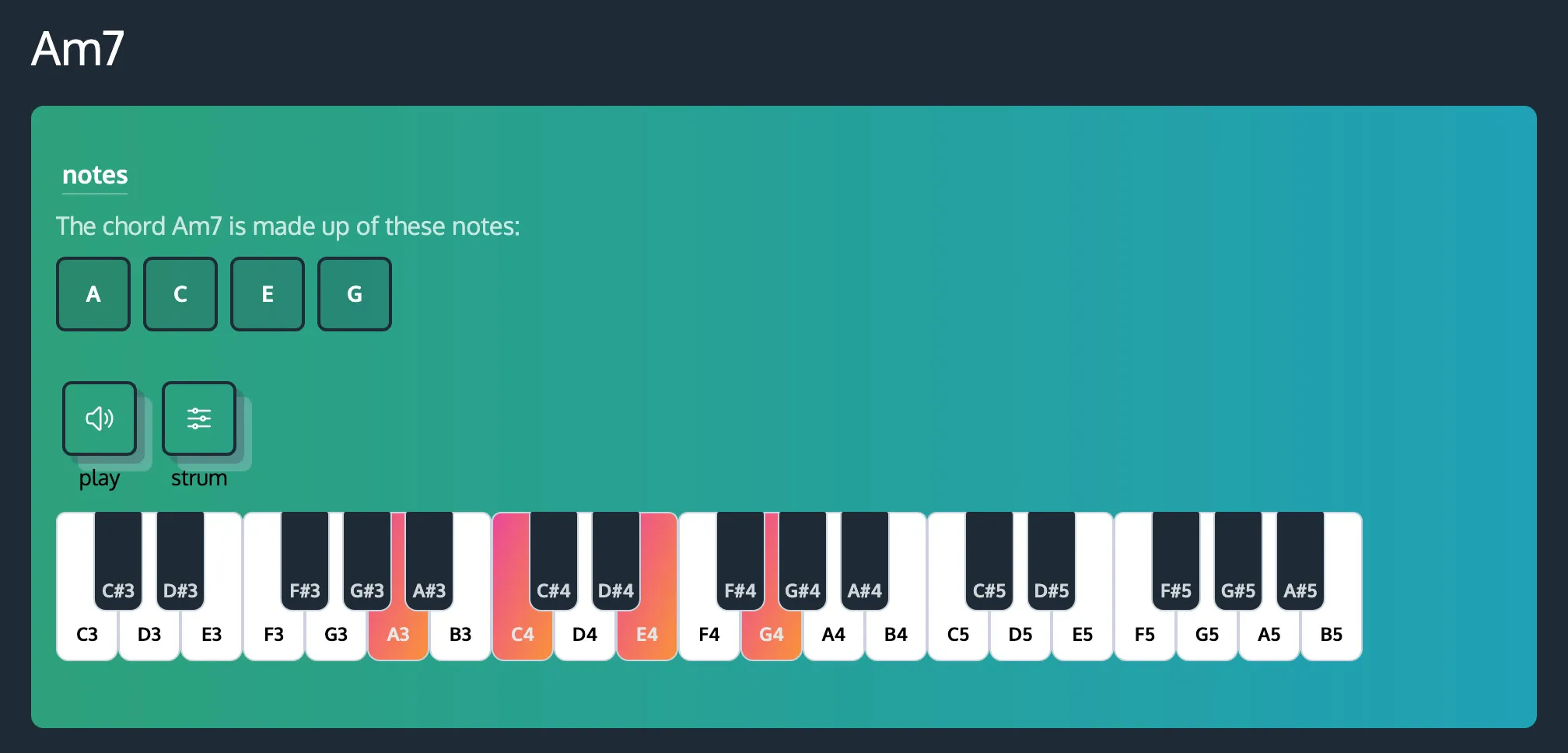
A minor 7th chord is a minor triad with a flattened 7th on top. Am7 is A, C, E, G. Dm7 is D, F, A, C. Em7 is E, G, B, D.
If you only learn one family of 7th chords, learn this one. A plain minor triad can sound stark, almost sad by default. Adding the flat 7th takes that edge off and leaves something warm and neutral, which is exactly why it dominates lo-fi, neo-soul, house and just about anything with a groove. It is a chord you can loop for four minutes without anyone getting tired of it.
Am7 is worth knowing cold, because it is the m7 chord most people meet first. All four notes are white keys, it sits under the hand comfortably, and it is the vi chord in C major, so it turns up constantly.
Notice what did not happen there: nothing resolved, and nothing needed to. Minor 7ths are happy to circle. That is the opposite of how dominant chords behave, and it is why a progression built from m7 chords feels like a bed rather than a journey.
Three things worth knowing about m7 chords in practice:
- They stack cleanly. Because there is no half-step clash inside the chord, you can voice a m7 in almost any order and it stays pleasant. Compare that to a dominant 7, which gets muddy fast in the wrong voicing.
- They replace minor triads for free. Anywhere a chart says Am, you can usually play Am7 instead and it will fit. The reverse is not always true.
- The 7th is the note doing the work. On Am7 that is the G. Drop it and you are back to a plain A minor, which is a useful test: play the chord, take the top note away, put it back.
If you want the extra note brighter rather than flatter, that is a different chord family. Cadd9 keeps the triad whole and stacks a 9th on top instead of a 7th, and a sus chord replaces the third rather than adding anything. Both change the colour without the pull that a 7th brings.
Dominant 7th: the one that has to move
A dominant 7th is a major triad with a flattened 7th. G7 is G, B, D, F. C7 is C, E, G, Bb. D7 is D, F#, A, C.
Written as a bare number with no “m” and no “maj”, so G7 rather than Gmaj7 or Gm7. That bare 7 always means dominant.
This is the unstable one, and the instability is structural rather than a matter of taste. Inside G7 sit a B and an F, three whole steps apart, and that interval genuinely does not want to stay where it is. Put G7 before C and the B slides up to C while the F slides down to E, and the whole thing clicks shut.
That is the single most common cadence in Western music, and it is why dominant 7ths appear at the end of almost every phrase in blues, jazz, gospel and older pop.
The blues then does something perverse with it: instead of resolving them, it builds the entire form out of dominant chords that never settle. C7, F7 and G7 over twelve bars, each one leaning somewhere and never arriving, which is exactly the point.
So the rule of thumb is: use a dominant 7 when you want motion, and put it a fifth above wherever you want to land. Want to arrive on C? Play G7 first. Want to arrive on F? Play C7 first.
Reading the symbol without guessing
Most of the confusion around 7th chords is notation, not theory. Chord symbols are compressed and inconsistent, and the same chord gets written four ways depending on who wrote the chart.
| You see | It means | Notes on C | Page |
|---|---|---|---|
| Cmaj7, CM7, CΔ7 | Major triad, major 7th | C, E, G, B | Cmaj7 |
| C7 | Major triad, flat 7th | C, E, G, Bb | C7 |
| Cm7, Cmin7, C-7 | Minor triad, flat 7th | C, Eb, G, Bb | Cm7 |
| Cm7b5, Cø7 | Diminished triad, flat 7th | C, Eb, Gb, Bb | Cm7b5 |
| Cdim7, C°7 | Diminished triad, double-flat 7th | C, Eb, Gb, Bbb | Cdim7 |
| CmMaj7, Cm(maj7) | Minor triad, major 7th | C, Eb, G, B | CmMaj7 |
Two rules get you through almost every chart:
- A lowercase m, “min” or a minus sign refers to the third. It tells you the chord is minor. It says nothing about the 7th.
- “maj” or a triangle refers to the 7th. It tells you the 7th is unflattened. On its own, a plain 7 always means flattened.
Which is why Cm7 and Cmaj7 are not opposites, and why CmMaj7 is not a typo. It is a minor triad with a major 7th, and it sounds like a spy film.
The two nobody teaches you
Beyond the big three there are two more 7th chords that turn up constantly and get skipped in most beginner guides.
Half-diminished (m7b5). A diminished triad with a flat 7th. Bm7b5 is B, D, F, A. It occurs naturally on the 7th note of a major scale and on the 2nd of a minor key, which means you cannot play a minor ii-V-i without it. It sounds tense but not unpleasant, more anxious than dramatic.
That is the minor ii-V-i, and it is worth having under your fingers. The Bm7b5 sets up the tension, the E7 sharpens it, and the Am7 lets it go.
Fully diminished (dim7). A diminished triad with a double-flatted 7th, so every note sits exactly three half steps from the next. Cdim7 is written C, Eb, Gb, Bbb, and that last one lands on the same key as A. Because the chord is perfectly symmetrical it has no obvious root, so it can slide into almost anything. Use it as a passing chord between two chords a whole step apart and it will usually work.
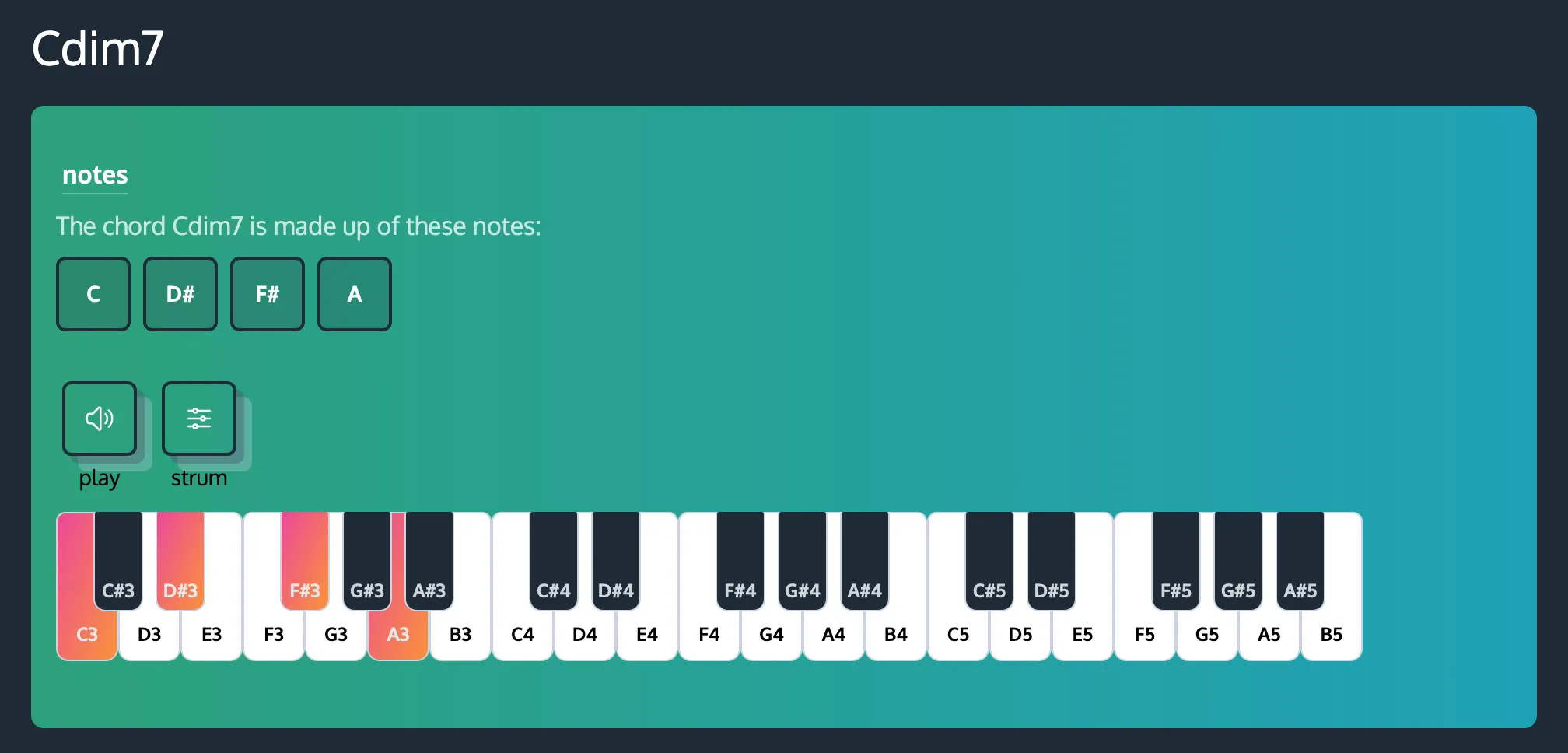
The keyboard makes the symmetry obvious in a way the note names hide. ChordCreate labels those keys with sharps, C, D#, F#, A, because that is what you press. The Eb, Gb, Bbb spelling is the same four keys written the way the theory requires, and this is a chord where the two conventions diverge more than usual.
Every 7th chord, all twelve roots
The three formulas transpose without thinking about it. Here is each one on every root, with the notes spelled out. Every chord links to its own page if you want the interactive keyboard, the inversions and a play button.
| Root | Major 7th | Minor 7th | Dominant 7th |
|---|---|---|---|
| C | Cmaj7 C, E, G, B | Cm7 C, Eb, G, Bb | C7 C, E, G, Bb |
| C# | C#maj7 C#, E#, G#, B# | C#m7 C#, E, G#, B | C#7 C#, E#, G#, B |
| D | Dmaj7 D, F#, A, C# | Dm7 D, F, A, C | D7 D, F#, A, C |
| Eb | Ebmaj7 Eb, G, Bb, D | Ebm7 Eb, Gb, Bb, Db | Eb7 Eb, G, Bb, Db |
| E | Emaj7 E, G#, B, D# | Em7 E, G, B, D | E7 E, G#, B, D |
| F | Fmaj7 F, A, C, E | Fm7 F, Ab, C, Eb | F7 F, A, C, Eb |
| F# | F#maj7 F#, A#, C#, E# | F#m7 F#, A, C#, E | F#7 F#, A#, C#, E |
| G | Gmaj7 G, B, D, F# | Gm7 G, Bb, D, F | G7 G, B, D, F |
| Ab | Abmaj7 Ab, C, Eb, G | Abm7 Ab, Cb, Eb, Gb | Ab7 Ab, C, Eb, Gb |
| A | Amaj7 A, C#, E, G# | Am7 A, C, E, G | A7 A, C#, E, G |
| Bb | Bbmaj7 Bb, D, F, A | Bbm7 Bb, Db, F, Ab | Bb7 Bb, D, F, Ab |
| B | Bmaj7 B, D#, F#, A# | Bm7 B, D, F#, A | B7 B, D#, F#, A |
Two notes on that table. Three of the dominant 7ths are filed on ChordCreate under their sharp names, so the Eb7 link opens the D#7 page, Ab7 opens G#7 and Bb7 opens A#7. Same keys under your fingers, different label on the door. And a few spellings look wrong and are not: C#maj7 really does contain a B#, which is the same key as C, because the 7th of C# has to be written as some kind of B. Play what your ear expects; the spelling is bookkeeping for the key signature.
Swapping a triad for its 7th chord
The fastest way to use any of this is to take a progression you already play and upgrade the chords one at a time.
Start with a plain I-vi-IV-V in C:
Now make the two major chords maj7, the minor chord m7, and leave the last one as a dominant so it still pulls back to the top:
Same four roots, same order, and it has gone from a campfire progression to something you could put a Rhodes on. That is the whole technique, and it works on most progressions you already know. Our six time-tested progressions are all good candidates, and the house progressions piece goes further into why sevenths in particular make a four-chord loop sound produced rather than plain.
Move the notes around before you move the chord
Four-note chords get heavy fast if you always play them root first. Most guides stop before this bit, which is a shame, because inversions are what make 7th chords sit properly under the hand.
An inversion just means starting the chord on a different one of its notes. Am7 has four:
| Inversion | Notes | Bottom note |
|---|---|---|
| Root position | A, C, E, G | the root |
| 1st inversion | C, E, G, A | the 3rd |
| 2nd inversion | E, G, A, C | the 5th |
| 3rd inversion | G, A, C, E | the 7th |
The practical use is smoother movement. Going from Am7 to Dm7 in root position means lifting your whole hand. Play Am7 in root position and Dm7 in second inversion and two notes stay exactly where they are, so the change sounds joined up rather than blocky. Every chord page on ChordCreate lists its inversions underneath the keyboard, so you can hear each one rather than work it out on paper.
Two more things to watch. First, do not make everything a 7th chord. If every chord floats, nothing stands out, and the progression turns to soup. Leave at least one plain triad in as a point of contrast. Second, keep the 7th near the top of the voicing and off the bottom. A flat 7th sitting low next to the root sounds muddy on a piano, which is the single most common reason a 7th chord that looks right sounds wrong.
If you want to hear any of these against a full progression rather than on their own, the Chord Finder has every chord above on its own page with playback, and you can look up chords by name from there or describe a mood and have the progression written for you.
Quick answers
What is a 7th chord? A four-note chord: a triad plus a note a 7th above the root. The three common types are major 7th (1, 3, 5, 7), dominant 7th (1, 3, 5, b7) and minor 7th (1, b3, 5, b7).
What is the difference between Cmaj7 and C7? One note. Cmaj7 is C, E, G, B and sounds settled. C7 is C, E, G, Bb and sounds unfinished, pulling towards F.
What notes are in Am7? A, C, E and G. It is an A minor triad with a G added on top, and every note is a white key.
Is Am7 the same as C major? Not quite, but they overlap. Am7 is A, C, E, G, and C major is C, E, G, so Am7 is a complete C major triad with an A underneath it. The bass note decides which one your ear hears, which is why C major over an A bass and Am7 sound so similar.
Why is it called a dominant 7th? Because it occurs naturally on the fifth note of a major scale, which is called the dominant. G7 is the dominant 7th chord in the key of C.
What does the m in Cm7 mean? It refers to the third, telling you the triad is minor. It says nothing about the 7th, which in Cm7 is flattened. A major 7th would be written Cm(maj7).
Which 7th chord should I learn first? Minor 7th. It is the most forgiving, it fits anywhere a minor triad fits, and it is the backbone of lo-fi, neo-soul and house.