What Is a Chord? Notes, Types and How to Read Them

A chord is two or more notes played at the same time. In practice, almost every chord you will meet is three notes stacked in thirds, which is called a triad, and it is the shape nearly all Western music is built on.
Here is the most ordinary chord there is, C major. Press play.
Three notes, C, E and G, sounding together. Everything below is about which notes get chosen, why, and how the name on a chord chart tells you.
What counts as a chord
Two notes at once are technically an interval, not a chord, and you will find music teachers who insist on that. Guitarists ignore them, because the power chord that most rock is built on is exactly two notes, a root and a fifth, and everyone calls it a chord.
The reason both camps have a point is that the argument is really about the third. A root and a fifth tell you which note is home but say nothing about the mood. It is the third note that makes a chord sound like something. That is why three notes is the working definition: it is the smallest group that has an opinion.
So: two or more notes played together is the honest answer, three stacked in thirds is what the word usually means.
The three notes in a triad
A triad is built by taking a note, skipping the next letter, taking the one after, skipping again, and taking the one after that. Start on C and you skip D to reach E, then skip F to reach G.
| Note | Its job | Distance from the root |
|---|---|---|
| C | the root, the note the chord is named after | none, this is the start |
| E | the third, decides major or minor | 4 semitones (a major third) |
| G | the fifth, adds weight and stability | 7 semitones (a perfect fifth) |
“A third” is a distance, not a count of keys. E is a third above C because it is the third letter name if you start counting at C itself: C, D, E. On a keyboard that is four semitones, so you move four keys including the black ones. Getting this wrong by one semitone is the single most common beginner error, and it turns every major chord you build into a minor one.
Stacking in thirds is not an arbitrary rule. Notes a third apart share enough of their overtones to blend into one sound rather than two, which is why a triad reads to the ear as a single object with a colour, instead of three separate pitches.
Major or minor, decided by one note
Lower that third by a single semitone and C major becomes C minor. The root and fifth do not move. Play them back to back:
One note, one semitone, and the whole character flips from bright to sombre. This is the most useful fact in beginner music theory, because it means you do not have to memorise two separate chord shapes for every root. You learn the major triad and you know where to find the minor one.
The usual shorthand is that major sounds happy and minor sounds sad. It holds up often enough to be worth knowing and breaks constantly in real songs, where tempo, rhythm and what comes next matter at least as much. Plenty of cheerful music is full of minor chords.
The other two triads
Major and minor cover most of what you will play, but there are four triad types in total. They differ only in which of the two upper notes gets moved.
| Triad | Formula | Notes on C | How it sounds |
|---|---|---|---|
| Major | 1, 3, 5 | C, E, G | settled, bright |
| Minor | 1, b3, 5 | C, Eb, G | settled, darker |
| Diminished | 1, b3, b5 | C, Eb, Gb | tense, unstable, wants to move |
| Augmented | 1, 3, #5 | C, E, G# | uneasy, suspended, dreamlike |
Diminished chords almost never sit still. Both of their upper notes are lowered, which leaves the outer interval a semitone short of a perfect fifth, and that instability is the point: a diminished chord is a signpost pointing at the chord after it. Augmented chords do something stranger. Because their three notes are evenly spaced, nothing in the chord sounds like the root, so the ear cannot tell where home is. The Beatles used one to open “Oh! Darling” precisely for that off-balance effect.
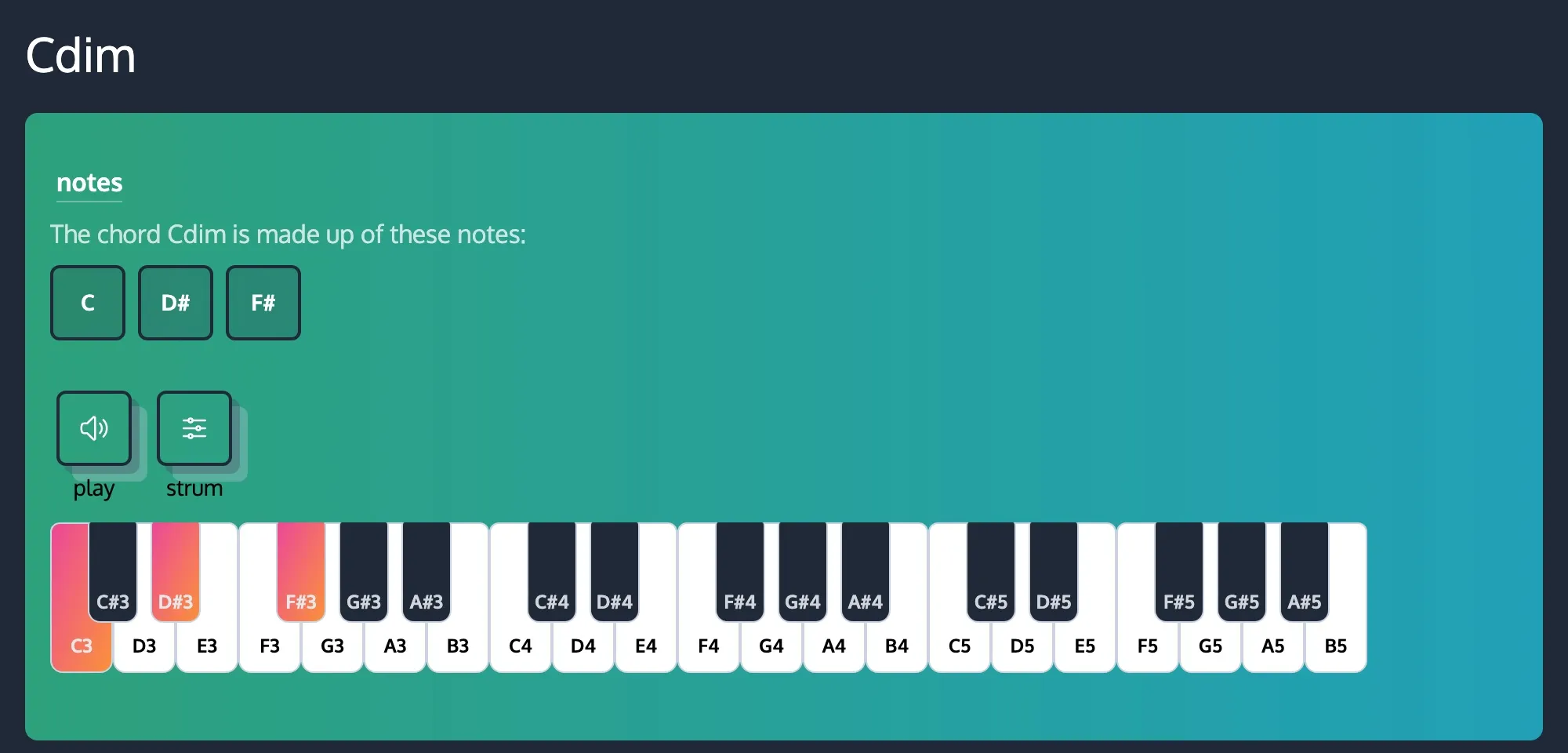
You may notice that page spells Cdim as C, D#, F# while the table above says C, Eb, Gb. Both name the same three piano keys. Theory writing prefers the flats because a triad should use every other letter (C, E, G), and sharps break that pattern; software and guitarists usually prefer the sharps because they are easier to read. When two chord names disagree about sharps and flats, count the semitones before assuming one of them is wrong.
There is a fifth possibility worth one sentence: take the third out entirely and replace it with the note either side, and you get a suspended chord, which is neither major nor minor. What sus2 and sus4 actually do covers those in full.
Adding a fourth note: 7th chords
Keep stacking thirds past the fifth and you land on the seventh. A four-note chord is richer and more specific than a triad, and which seventh you add changes the chord’s job completely.
| Chord | Notes | Character |
|---|---|---|
| Cmaj7 | C, E, G, B | soft, floating, jazzy calm |
| C7 | C, E, G, Bb | restless, bluesy, pulls forward |
| Cm7 | C, Eb, G, Bb | mellow, smooth, neutral |
The gap between Cmaj7 and C7 is one semitone on the top note, and it is the difference between a chord that wants to rest and a chord that wants to resolve. That restlessness is why the dominant seventh, the C7 shape, drives almost all blues and most cadences in pop.
There is more to say about all three than fits here, including the two seventh chords most guides skip and how to read the symbols without guessing. Our guide to 7th chords takes each one in turn and gives you all three on every root note.
The fourth note does not have to be a seventh. Skip it and add the 9th instead and you get an add9 chord, which stays as stable as the plain triad but sounds brighter and more open.
How to read a chord name
Chord symbols look cryptic until you notice they are always assembled in the same order: the root, then the quality, then anything extra, then an optional bass note.
| Symbol | Reads as | Notes |
|---|---|---|
| C | C major | C, E, G |
| Cm | C minor (also written Cmin or C-) | C, Eb, G |
| C7 | C dominant 7th | C, E, G, Bb |
| Cmaj7 | C major 7th (also CM7 or CΔ) | C, E, G, B |
| Cm7 | C minor 7th | C, Eb, G, Bb |
| Cdim | C diminished (also C°) | C, Eb, Gb |
| Caug | C augmented (also C+) | C, E, G# |
| Cadd9 | C major with a 9th added on top | C, E, G, D |
| C/G | C major with G in the bass | C, E, G, lowest note G |
Two traps in that list. A bare number with no word in front of it, like C7, always means a dominant seventh, never a major seventh. And a slash never means “or”: C/G is one chord with a specified bass note, not a choice between two.
If you meet a name that is not in the table, look it up in the chord finder and you will get its exact notes, an interactive keyboard and a play button.
Chords on piano and guitar
The theory is identical on every instrument. The physical experience is not.
On a piano the structure is visible. A C major triad is three keys with one white key skipped between each, and moving the third down a semitone to make it minor is one obvious step to the left. If you do not have a keyboard nearby, virtual piano chords walks through finding a chord’s keys and hearing it in a browser.
On a guitar the same three notes are spread across six strings in a shape your hand memorises, often with notes doubled in different octaves. That is why guitarists tend to learn chords as shapes first and understand the theory afterwards, and it works fine. The chord is the set of pitches, not the fingering.
From one chord to a progression
A single chord is a colour. Music happens when you put several in order, which is called a chord progression.
That one is C, G, Am, F, and you have heard it in hundreds of songs. Nothing in it is clever; the chords all belong to the key of C and the order simply moves away from home and back.
Not every chord in a progression has to belong to the key, though. Borrowing one from the parallel minor, most often the bVII or the bVI chord, is how a lot of rock and film music gets its weight without leaving the key entirely.
Where to go next depends on what you want:
- The mechanics of ordering chords: what is a chord progression
- Progressions that already work, ready to steal: six time-tested chord progressions
- Naming a chord you can hear but cannot identify: identifying chords by ear
Quick answers
What is a chord in music? Two or more notes played at the same time. Most chords are triads: three notes stacked in thirds, such as C, E and G for C major.
What is the difference between a chord and a note? A note is one pitch. A chord is several pitches sounding together, so a chord is made of notes in the way a word is made of letters.
Can two notes be a chord? Strictly a two-note group is an interval, but in practice yes. The power chord, a root and a fifth with no third, is two notes and is universally called a chord.
What is a triad? A three-note chord built by stacking two thirds on top of a root. The four triad types are major, minor, diminished and augmented.
What makes a chord major or minor? The third. A major third above the root, four semitones, gives a major chord. Lower it one semitone to a minor third and the chord becomes minor. The root and fifth are the same in both.
How many notes are in a chord? Usually three or four. Triads have three, 7th chords have four, and extended chords such as 9ths and 13ths can have five or six.
What does the 7 in C7 mean? It adds a fourth note a flattened seventh above the root, Bb in the case of C7. A plain number always means a dominant seventh; a major seventh is written Cmaj7.
What does a slash in a chord name mean? It names the bass note. C/G is a C major chord with G as its lowest note, not a choice between C and G.