House Chord Progressions: 10 Deep, Piano & Afro House Loops
House chord progressions are usually four chords looped for the length of a track, built from sevenths and ninths rather than plain triads, and sitting in a minor key more often than not. The progressions themselves are not exotic. What makes them sound like house is the chord quality, the register you play them in, and where in the bar they land.
That last point is the one most guides skip, so start with it. Here is a plain Am to F to C to G, the most over-used four chords in pop music:
And here is the same four chords with the thirds extended into sevenths and ninths:
Same roots, same order, same tempo. The second one is halfway to a house record and the first one is not. Everything below is about closing the other half.
All 10 house chord progressions at a glance
These are the ten house chord progressions covered on this page, with their Roman numerals, exact chords and tempo. Each one is playable further down and transposes cleanly to any other key, so use the table as a lookup and the sections below for the why.
| # | Style | Roman numerals | Chords | BPM |
|---|---|---|---|---|
| 1 | Piano house | I, V, vi, IV | Cmaj7, G, Am7, Fmaj7 | 126 |
| 2 | Piano house | vi, ii, V, I | Am7, Dm7, G7, Cmaj7 | 124 |
| 3 | Deep house | i, iv (two-chord loop) | Am9, Dm9 | 122 |
| 4 | Deep house | i, iv, V, i | Dm9, Gm9, A7, Dm9 | 121 |
| 5 | Deep house | i, iv, VI, V | Cm9, Fm9, Abmaj7, G7 | 120 |
| 6 | Melodic house | vi, IV, I, V | Am, Fmaj7, Cadd9, Gsus4 | 123 |
| 7 | Melodic house | i, VI, III, VII | Fm, Dbmaj7, Abmaj7, Eb | 124 |
| 8 | Progressive house | vi, IV, I, V | Bm7, Gmaj7, Dmaj7, A | 126 |
| 9 | Afro house | i, IV (Dorian vamp) | Am7, D9 | 118 |
| 10 | Soulful house | i, VII, VI, v | Am7, G6, Fmaj7, Em7 | 120 |
If you only try one, try number 3. Two minor 9th chords is the least material that still sounds unmistakably like deep house, which makes it the quickest way to hear what the rest of this page is about.
Why the same four chords sound like pop in one track and house in another
Pick almost any house track apart and the harmony underneath is ordinary. I to V to vi to IV shows up constantly. So does the jazz turnaround vi to ii to V to I. If a progression were enough on its own, every pop song would be a house record.
The difference is that house treats the chord as a rhythmic and textural event rather than a harmonic one. A pop arrangement holds a chord for a bar and lets a vocal sit on top. A house arrangement usually plays a short stab on an off-beat, leaves silence around it, and repeats that for eight minutes.
That repetition is the constraint everything else follows from. The harmony has to survive being heard hundreds of times, which is why producers reach for chords with more internal colour: a four-note or five-note voicing keeps rewarding a listener in a way a triad stops doing after the second loop.
So the useful way to read the house chord progressions below is not “these are the ones house uses.” It is: these hold up under repetition, and here is the chord quality that makes each one hold up.
Three things that turn a progression into a house progression
Sevenths and ninths instead of triads
This is the single biggest lever. Deep house in particular lives on minor 7ths and minor 9ths, and the major chords are almost always major 7ths rather than bare triads. Adding the seventh gives you a fourth voice that moves independently of the root, and the ninth adds a fifth.
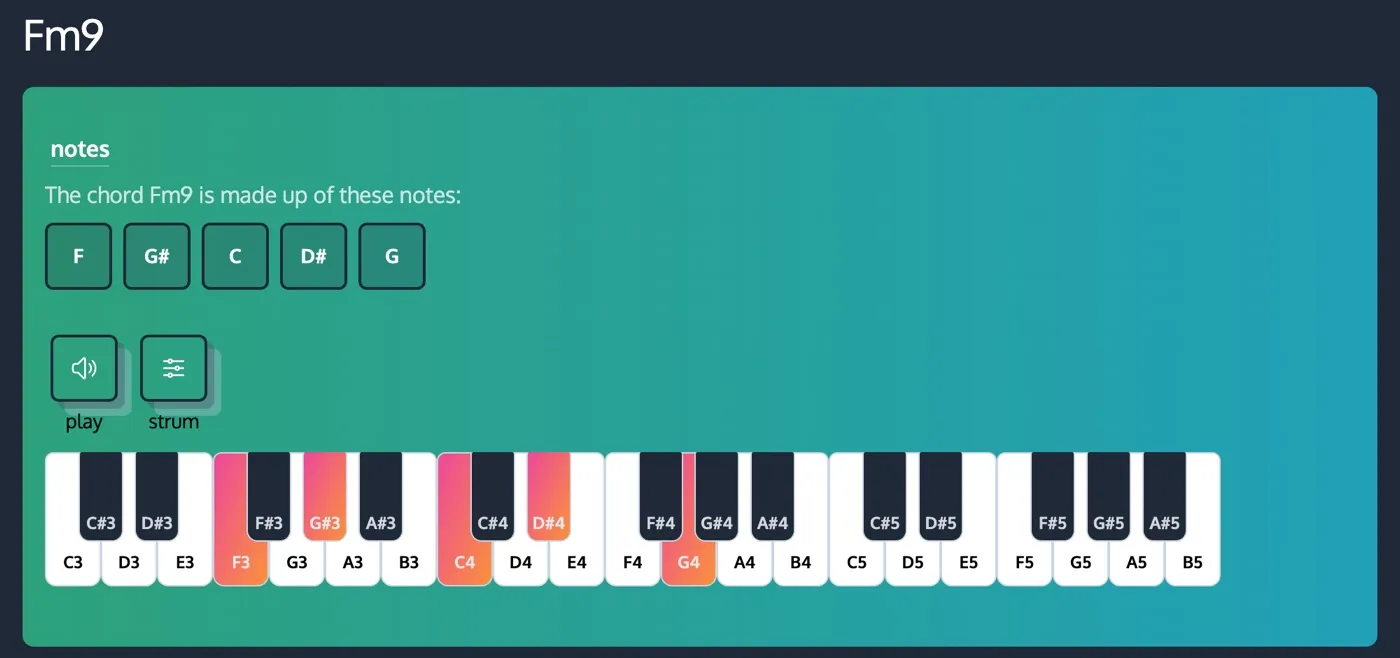
An Fm9 is F, A flat, C, E flat and G. Five notes, two of which (the seventh and the ninth) are doing the work a triad cannot do. Play it, then play a plain Fm, and the gap between them is roughly the gap between a demo and a release.
The practical rule: take whatever progression you have, and extend every minor chord to a minor 7th or 9th, and every major chord to a major 7th. Then remove the extension from any chord where it muddies the bass. That single pass gets most beginner progressions most of the way there.
The chord lands off the beat
House is four on the floor, so the kick owns beats 1, 2, 3 and 4. If the chords land there too, they fight the kick and the whole thing turns to mud. The convention is to put the chord on an off-beat, most commonly the “and” of each beat, so it answers the kick instead of colliding with it.
You cannot hear this in the players on this page, which play chords straight and evenly so you can judge the harmony on its own. You will hear it the moment you move the notes in your DAW. Nudge every chord an eighth note later and a stiff loop starts to swing.
Voicing: one hand, middle of the keyboard
Extended chords played across two octaves sound like a jazz piano recording, not a house stab. Keep the whole chord inside roughly one octave in the middle of the keyboard, around C3 to C5, and let the bassline handle everything below that. If a chord sounds cluttered, the fix is usually an inversion rather than a different chord. Every chord page on this site lists its inversions for exactly this reason.
House music chords: the qualities that carry the genre
If you strip the progressions away and just count chord types, house uses a small, consistent vocabulary. These are the house chords worth knowing by ear, with one or two examples of each you can open and play.
| Chord quality | Example | What it adds | Where you hear it most |
|---|---|---|---|
| Minor 7th | Dm7 | Softens a minor chord without darkening it | Everywhere, the default minor chord in house |
| Minor 9th | Am9 | Width and a slight shimmer on top | Deep house, the signature sound |
| Minor 11th | Am11 | An open, unresolved, almost modal colour | Deep and Afro house stabs |
| Major 7th | Cmaj7 | Warmth, takes the brightness off a major chord | Piano and soulful house |
| Major 9th | Cmaj9 | A lusher version of the major 7th | Soulful and garage-leaning house |
| Dominant 7th and 9th | G7, D9 | Pull back towards the tonic, or a Dorian lift | Turnarounds, Afro house vamps |
| Sixth | C6 | A lighter, older colour than the major 7th | Soulful and disco-rooted house |
| Sus4 and add9 | Gsus4, Cadd9 | Delay or blur resolution | Melodic and progressive house |
The minor 7th, minor 9th and major 7th rows cover the majority of what you will hear. The guide to 7th chords explains how each seventh is built, and the add9 chords guide covers the difference between an add9 and a full ninth chord, which matters once you start stacking extensions for house.
The sound matters as much as the chord
Classic house chords are rarely played on a concert grand. Chicago house drew on organ, string-machine stabs and piano side by side from the mid-1980s on, and the bright, slightly hollow piano sound that later defined piano house is largely one preset, the Korg M1’s factory piano, not an acoustic recording. Deep house tends toward electric piano and soft pads. The same Am9 played on each of those reads as three different subgenres.
When you audition progressions in ChordCreate you can switch the playback sound, and Electric Grand Piano, Drawbar Organ and Warm Pad are all in the list (they are part of the paid sound set; Kawai Grand Piano, Soft Piano and Heaven’s Keys are free). That is enough to hear whether a progression wants to be a piano house stab or a deep house pad before you commit to it in your DAW.
Classic piano house progressions
Major key, bright, built around a piano stab. These run fast, roughly 124 to 128 BPM, and lean on major 7ths to stop the brightness turning brittle.
1. I to V to vi to IV, extended. The familiar four chords with the thirds opened up. This is the backbone of a large amount of vocal and piano house.
Note that the G stays a plain triad. Leaving one chord unextended gives the loop a point of contrast, and the V is the natural place for it.
2. The jazz turnaround, vi to ii to V to I. Borrowed wholesale from jazz and garage, and the reason so much house sounds like it has more harmony than it does.
The roots fall in fourths, which is the smoothest root movement available. Every chord shares two notes with the next one, so the voicing barely has to move.
Deep house progressions
The deep house chord progressions below are minor, slower, roughly 118 to 124 BPM, and this is where the ninths earn their keep. Deep house is the subgenre where chord quality does the most work, because the arrangements are sparse enough that there is nowhere for a weak chord to hide.
3. The two-chord oscillation. Two chords, looped, forever. It sounds like it should be boring and it is the most reliable deep house device there is.
With ninths on both chords there is enough internal movement that the loop keeps breathing. Try the same thing with plain Am and Dm and it dies in four bars.
4. i to iv to V to i in D minor. A dominant V chord in a minor key, which pulls harder back to the tonic than the diatonic minor v would.
The A7 contains a C sharp that is not in D natural minor. That one note is what makes the return to Dm9 feel like an arrival rather than just the next bar.
5. i to iv to VI to V in C minor. Four chords, all extended, and the most straightforwardly moody thing on this list.
Abmaj7 and Cm9 share three notes between them, so the third chord lifts without the voicing jumping. That kind of overlap is worth checking whenever a progression feels like it lurches.
If you want the loop bleaker than this, the shapes in the sad chord progressions guide transfer directly: extend them the same way and they become deep house rather than ballad material.
Melodic and progressive house progressions
Wider, more emotional, usually 122 to 126 BPM, and often built to run for sixteen bars before anything changes. Suspended chords show up a lot here because they delay resolution, which is useful when you are filling a long build.
6. vi to IV to I to V, with the resolution held back. The plain version of this is pop. The sus4 on the last chord is what stops it landing.
Gsus4 never resolves to G, so the loop restarts on an unanswered question. If you want more on how that works, the sus chords guide covers what suspensions do and when to release them.
7. i to VI to III to VII in F minor. The darker melodic house shape, entirely diatonic, and it can loop indefinitely without fatiguing.
8. vi to IV to I to V in D. Same relationship as number 6, a different key, and every chord extended.
Ending on a plain A after three extended chords gives the loop a clean edge to restart from. This is a good default when a progression sounds like it never quite finishes.
Afro house and soulful house progressions
Slower again, roughly 115 to 122 BPM, and more modal. The harmony often stops moving entirely and lets percussion carry the track.
9. The Dorian vamp. Two chords, one of which is not in the natural minor scale at all.
D9 contains an F sharp, which turns A minor into A Dorian. That raised sixth is most of the reason Afro house sounds warmer and less mournful than deep house built on the same root.
10. The descending minor loop. A soulful house staple that walks down the scale rather than jumping around it.
The G6 in second position is an unusual choice and worth stealing. A plain G would work; the sixth keeps the top voice moving by step while the roots descend.
Generate a house progression from a prompt
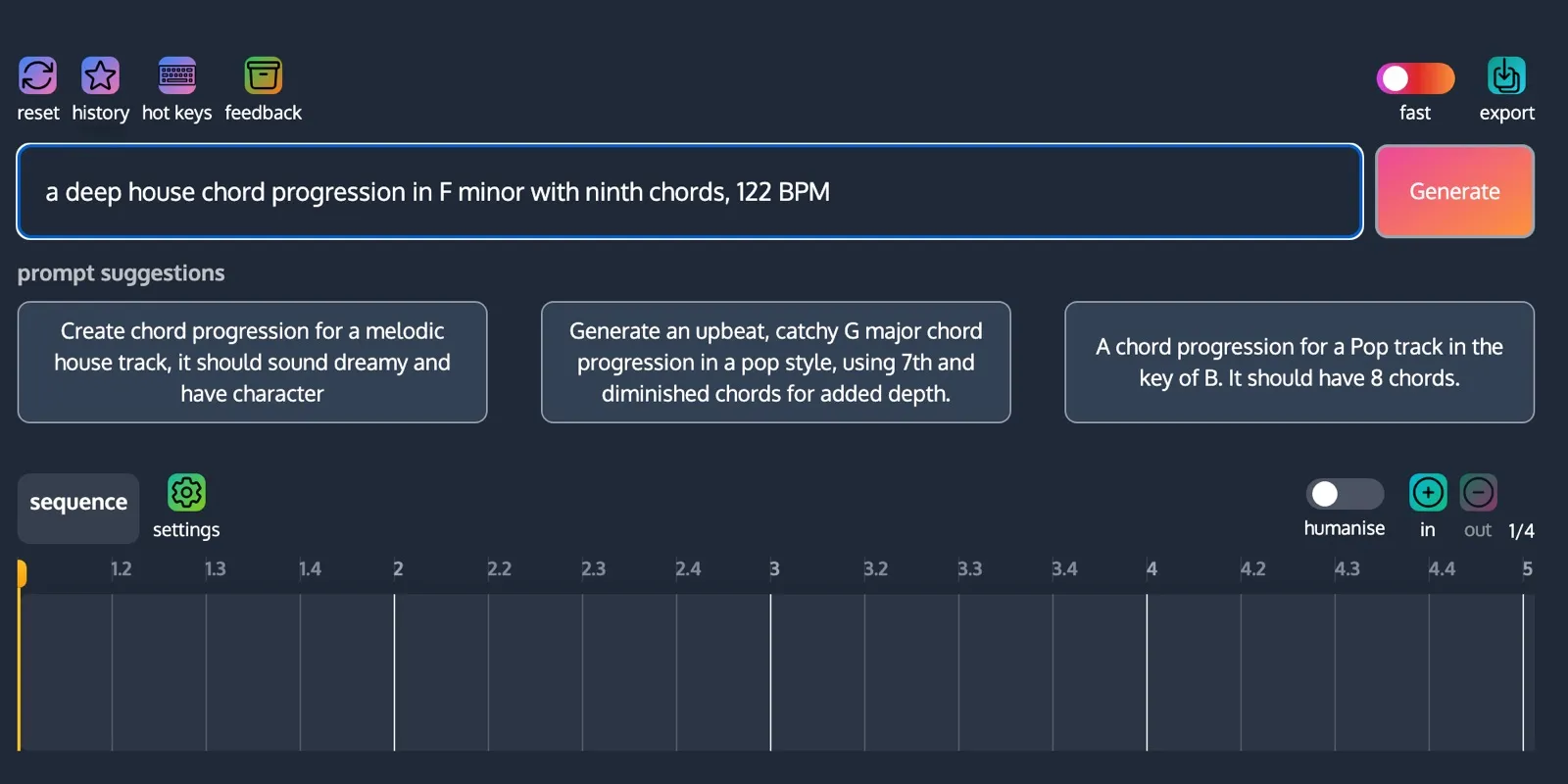
If you would rather start from a description than from a table, ChordCreate builds house chord progressions from a plain-language prompt and returns something you can hear, rearrange and export. Naming the subgenre, the key and the chord quality matters more than writing a long prompt.
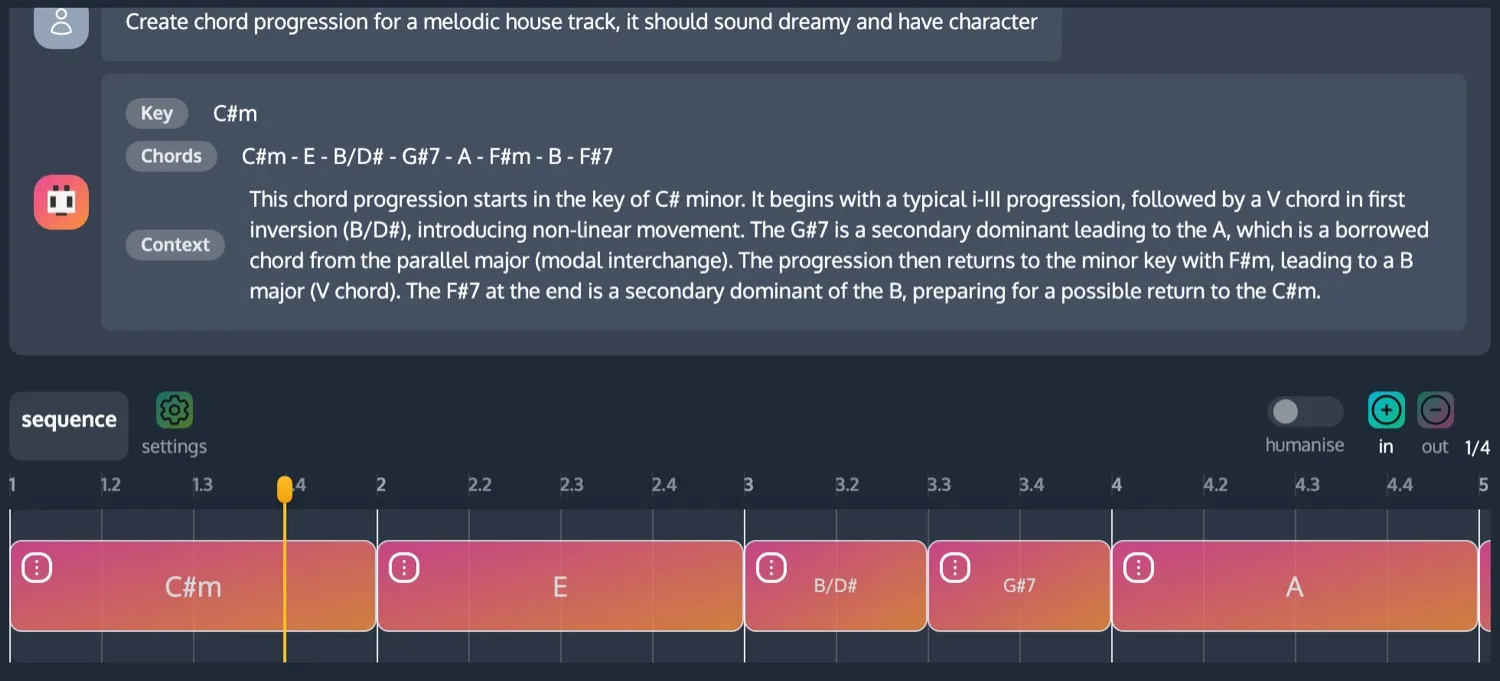
The example above came from “Create chord progression for a melodic house track, it should sound dreamy and have character,” and it returned an eight-chord progression in C sharp minor along with the reasoning: a first-inversion V chord for non-linear movement, a secondary dominant leading into a borrowed chord from the parallel major. That explanation is the part worth reading, because it tells you which chord to change when the loop is nearly right.
Prompts that work well for this genre follow the same shape:
| Prompt | What it pins down |
|---|---|
| “a deep house progression in F minor using minor 9th chords, 122 BPM” | subgenre, key, chord quality, tempo |
| “a warm Afro house vamp in A Dorian, only two chords” | subgenre, mode, length |
| “an uplifting piano house progression in C major with major 7ths” | subgenre, key, chord quality |
| “a melodic house progression that does not resolve, 16 bars” | subgenre, harmonic behaviour, length |
Asking for a specific chord quality is the highest-value part of the prompt for house, for the reason set out above: the quality is what carries the genre. The full guide to prompting for chord progressions goes deeper on the other levers.
Getting the chords into your DAW
House chord progressions are only useful once they are in the project. Export the sequence as MIDI and drop the file onto a track in your DAW, then do the two things the browser cannot do for you: shift every chord an eighth note later so the stabs answer the kick, and shorten the note lengths so each chord is a stab rather than a pad.
From there the usual house arrangement moves apply. Filter the chords out for the intro and open the filter across the build. Drop the chords entirely for a bar before the drop so their return does the lifting. Layer a pad playing the same chords two octaves up if the mid range feels thin.
Quick answers
What chords are used in house music? Mostly minor 7ths, minor 9ths and major 7ths rather than plain triads. Deep house leans hardest on minor 9ths, piano house on major 7ths, and Afro house often uses a Dorian vamp with a dominant chord built on the fourth.
What is the most common house chord progression? There is no single one, but the most common shapes are a two-chord minor 9th loop (i to iv) in deep house, and the extended I, V, vi, IV and vi, ii, V, I in piano house. All three are in the table at the top of this page.
How many chords does a house track need? Two to four. Four is the common case and two is genuinely enough, provided the chords are extended enough to stay interesting through repetition.
What key is house music usually in? Minor keys dominate, with A minor, D minor, F minor and C minor being the most common. Piano house is the main exception and is often in a major key.
How long should a house chord progression be? Four bars in the vast majority of cases, with one chord per bar, looped. Eight-bar and sixteen-bar loops turn up in melodic and progressive house where there is more time to fill.
What BPM are house chord progressions written at? Roughly 115 to 128. Afro house and deep house sit at the slower end, classic piano house and progressive house at the faster end.
Why do my house chords sound thin? Usually triads instead of sevenths, a voicing spread over too many octaves, or chords landing on the beat where they fight the kick. Fix them in that order.
Do house progressions have to be in a minor key? No. Classic piano house is frequently major. What matters more than the key is that the chords are extended and that they land off the beat.