Sad Chord Progressions: 12 Grouped by Mood
Sad chord progressions almost always come down to three things: a minor chord you keep returning to, movement that descends rather than climbs, and an ending that refuses to settle. The most used one in popular music is Am, F, C, G, and you can hear exactly what that combination does here:
But “sad” is a bucket holding several different feelings. Wistful is not the same as heartbroken, and neither one is bleak. Most lists of sad progressions hand you twenty roman numerals in a row without saying which sadness each one produces, which is the only thing you actually need to know when you are writing. This one groups them by feel, and every progression on the page is playable, so you can hear the difference instead of taking my word for it.
What actually makes a chord progression sound sad
Minor chords are the obvious answer and they are only part of it. Plenty of genuinely devastating songs sit in a major key. Six mechanics do most of the work:
| Mechanic | What it does | Quickest example |
|---|---|---|
| A minor tonic | Makes the chord you keep coming home to a minor one, so “resolved” still sounds unhappy | Starting and ending on Am |
| Descending motion | Bass or top line falls step by step, which reads as sinking or giving up | Am, G, F, E |
| A borrowed minor iv | Swaps a bright IV chord for its minor version, borrowed from the parallel minor key | F becoming Fm in C major |
| No leading tone | Using a minor v instead of a major V removes the note that pulls you home, so nothing rescues the phrase | Em instead of E in A minor |
| An unresolved ending | Finishing on anything except the tonic leaves the loop hanging | Ending the bar on VI or VII |
| Space and tempo | Slow, sparse and low-register lets the harmony land. The same chords at 140bpm sound like a dance track | 70 to 85bpm, whole-bar chords |
The two mechanics worth hearing back to back are the tonic and the borrowed minor iv, because both change the emotion without changing much else.
Same four chords, different home. C, G, Am, F is one of the happiest sounds in pop. Rotate it so the minor chord comes first and the identical four chords turn melancholy:
Nothing changed except which chord your ear treats as home. That is worth remembering when a progression is not landing: you may already have the right chords in the wrong order.
One chord turned minor. Here is a plain major cadence, then the same thing with the F swapped for an Fm:
That single flattened note is the most reliable heartbreak trick in songwriting, and it works in a major key with no minor tonic anywhere in sight.
Wistful and nostalgic
These sound like looking back at something rather than hurting right now. They are the safest place to start, and they suit lyrics about memory, distance and time passing.
1. i, VI, III, VII
The workhorse. Every chord is comfortable, nothing is dissonant, and the sadness comes purely from starting and finishing on the minor. Worth knowing: these are the same four chords as the major-key pop axis, rotated. If you have written this by accident, you are in good company, most people do.
2. i, VII, VI, VII
A circling vamp that goes down and then only halfway back up. Because it never touches the III chord it never brightens, and because it never resolves anywhere new it can loop under a whole verse without wearing out. Good for anything that needs to feel stuck.
3. i, III, VII, IV
The shape behind “Mad World”. The A major at the end is borrowed from Dorian, and that one bright chord is what keeps it from tipping into despair. It is sad in a slightly detached, observational way rather than a devastated one.
Heartbroken and aching
Now the sadness is aimed at something. These lean on tension that gets set up and then denied.
4. i, VI, VII, v
The chord that does the damage is the last one. A major E would pull you back to Am and close the loop, and using minor Em instead removes the leading tone entirely, so the phrase just stops mid-air. Splice identifies this shape in the chorus of Evanescence’s “My Immortal”, which is about right for how it feels.
5. i, iv, VII, III
Each root moves up a fourth, A to D to G to C, which is the strongest pull in tonal harmony. It sounds like being carried somewhere you did not choose to go. The arrival on C is a genuine moment of light, and the fact that the loop drags you straight back to Am is the point.
6. i, VI, ii dim, V
The classical one, and the shape Beethoven opens the first movement of the “Moonlight Sonata” with. Bdim is genuinely unstable, and the major E after it (borrowed from harmonic minor) creates a much stronger pull home than anything in the pop progressions above. Strong pull plus minor destination is what makes it ache rather than mope. Play it slowly or it turns into a waltz.
Bleak and hopeless
No light in these at all. Use them sparingly, and mostly in short sections rather than under a whole song.
7. i, VII, VI, V
The Andalusian cadence, centuries old and still the most efficient descent in music. The bass walks down A, G, F, E and lands on a major V that promises resolution the loop never delivers. Flamenco, film scores and metal all live here.
8. i, iv, v, i
Pure natural minor with no borrowed chords, no major relief and a minor v that refuses to lift. It resolves properly, which is what makes it bleak rather than tense: you get the closure and it changes nothing.
9. i, bII, i
Two chords a semitone apart. The Bb is a Phrygian move and it sits so close to the Am that the pair feels claustrophobic. This is dread more than grief, and it is why the shape turns up constantly in horror and thriller scoring.
Bittersweet, in a major key
The most useful group, and the one most lists skip. No minor tonic, and still sad.
10. I, III, IV, iv
The “Creep” progression. The B major is a surprise (you expect Bm in G major), and then the Cm is the borrowed minor iv from the table above. Two unexpected chords in four, and the whole thing still sounds inevitable.
11. I, iii, vi, IV
The shape behind Adele’s “Someone Like You”. Technically A major throughout, but going I to iii to vi puts two minor chords in the middle of the phrase and greys the whole thing out. This is the progression to reach for when the lyric is sad but the song still needs to feel warm.
12. vi, V, IV, iii
A pure stepwise fall through C major that starts on the relative minor and ends on Em, so it never touches the tonic at all. Four chords, all diatonic, nothing borrowed, and it still sounds like the floor giving way. Descent alone is enough.
The same progressions in your key
Everything above is written in one key for consistency. Here is what the scale degrees are in the six minor keys most people actually write in, so you can move any of these anywhere:
| Key | i | ii dim | III | iv | v | VI | VII |
|---|---|---|---|---|---|---|---|
| A minor | Am | Bdim | C | Dm | Em | F | G |
| E minor | Em | F#dim | G | Am | Bm | C | D |
| D minor | Dm | Edim | F | Gm | Am | Bb | C |
| B minor | Bm | C#dim | D | Em | F#m | G | A |
| C minor | Cm | Ddim | Eb | Fm | Gm | Ab | Bb |
| F# minor | F#m | G#dim | A | Bm | C#m | D | E |
Read a progression like i, VI, III, VII across the row you want. In D minor it is Dm, Bb, F, C. In C minor it is Cm, Ab, Eb, Bb. The feeling travels with the shape, not the letters.
Two practical notes on choosing a key. Guitar strongly favours Am, Em and Dm because the open strings ring. Vocals should decide it for you if there is a singer: pick the key that puts the highest note of the chorus at the top of a comfortable range, then transpose the chords to match.
Making a progression sadder without changing the chords
Once the shape is right, most of the remaining emotional distance comes from performance rather than harmony.
- Slow down and hold longer. Most of these sit best between 66 and 85bpm with one chord per bar. Two chords per bar makes almost any of them sound busy rather than sad.
- Walk the bass down. Play Am, then Am with G in the bass, then F, then E. The chords barely move but the bass line descends by step, which is mechanic two from the table doing its job.
- Add the seventh, then the ninth. Am7 is softer and more resigned than Am. Am9 is softer still. If a progression sounds blunt rather than sad, this is usually why.
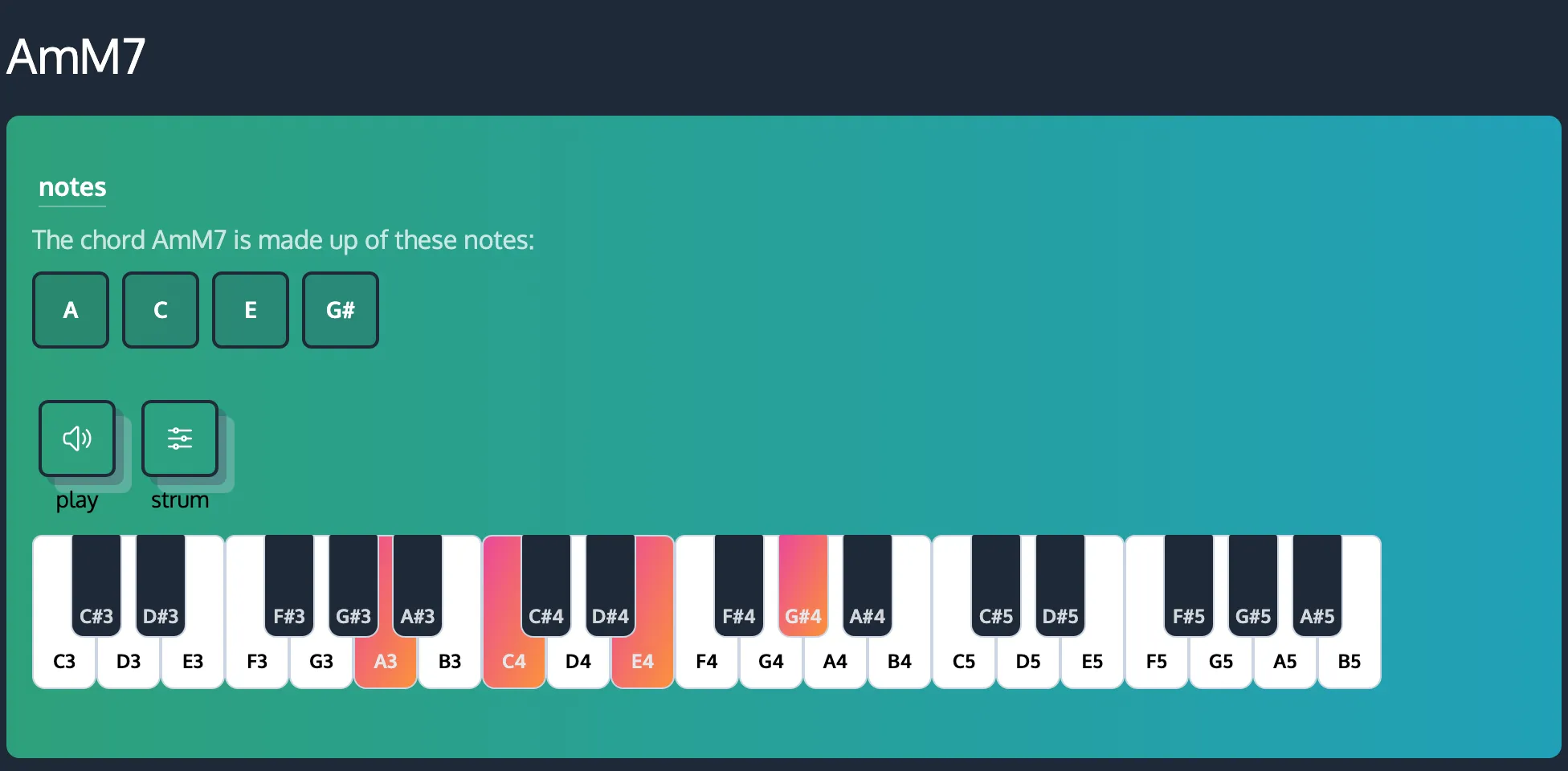
- Try the minor-major seventh. Am(maj7), written AmM7 in the Chord Finder, holds a minor triad and a major seventh together, which is unsettled in a very specific, cinematic way. One bar of it is plenty.
- Open the voicing. Move the root down an octave and let the other notes spread out. Chords crammed into one octave sound thick. Space sounds lonely.
- Kill the leading tone. Anywhere you have a major V in a minor key, try the minor v instead and listen to what disappears.
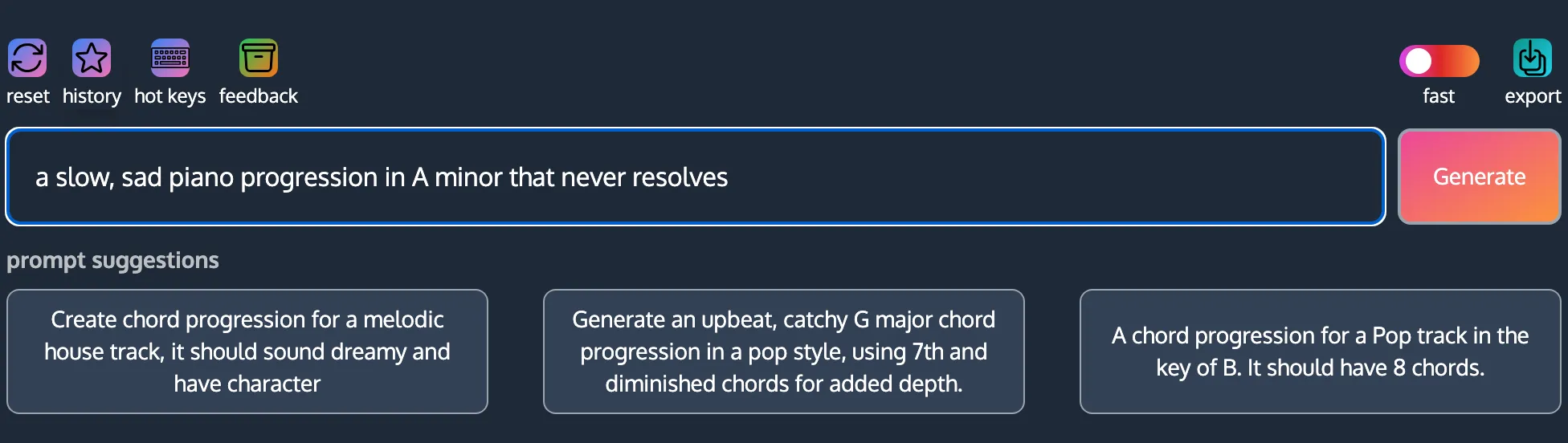
If you would rather start from the feeling than the theory, describing it in plain language is faster: ChordCreate’s generator takes something like “slow, sad piano in A minor, unresolved” and writes a progression to match, which you can then edit chord by chord. There is a full walkthrough in how to generate a chord progression from a text prompt.
Where to go from here
Sad is one mood among many, and the mechanics on this page invert cleanly. Major tonic, ascending motion and a resolved ending give you the opposite. If you want the wider context, what is a chord progression covers how progressions are built in the first place, and 6 time-tested chord progressions works through the shapes that turn up in every genre, sad or not. If a chord in this article was unfamiliar, the Chord Finder will show you its notes and play it. And if you produce rather than write, most of these minor shapes turn into house chord progressions once you extend them into sevenths and ninths.
Quick answers
What is the saddest chord progression? There is no single saddest one, but i, VII, VI, V (Am, G, F, E) is the most reliably bleak because the bass descends by step and the final major chord promises a resolution that never arrives.
Do sad chord progressions have to be in a minor key? No. Borrowing a minor iv chord into a major key, as in I, III, IV, iv, produces some of the saddest sounds in popular music without a minor tonic anywhere.
What is the most common sad chord progression? i, VI, III, VII, which is Am, F, C, G in A minor. It uses the same four chords as the major-key pop axis, rotated so the minor chord is home.
Why do minor chords sound sad? A minor chord has a flattened third, a slightly narrower interval above the root than a major chord. Western listeners learn that contrast by exposure rather than by physics, which is why the association is strong but not universal across musical traditions.
How do I make a chord progression sound sadder? Slow it to around 70bpm, hold each chord for a full bar, make the bass line descend by step, add sevenths or ninths to the minor chords, and replace any major V chord with a minor v.
What tempo suits a sad chord progression? Roughly 66 to 85bpm for most of the progressions here. Space between chords is what lets the harmony register, and the same chords above about 110bpm stop reading as sad.